Is It Fair to Kill the Violent Offender So They Won t Be a Threat Again
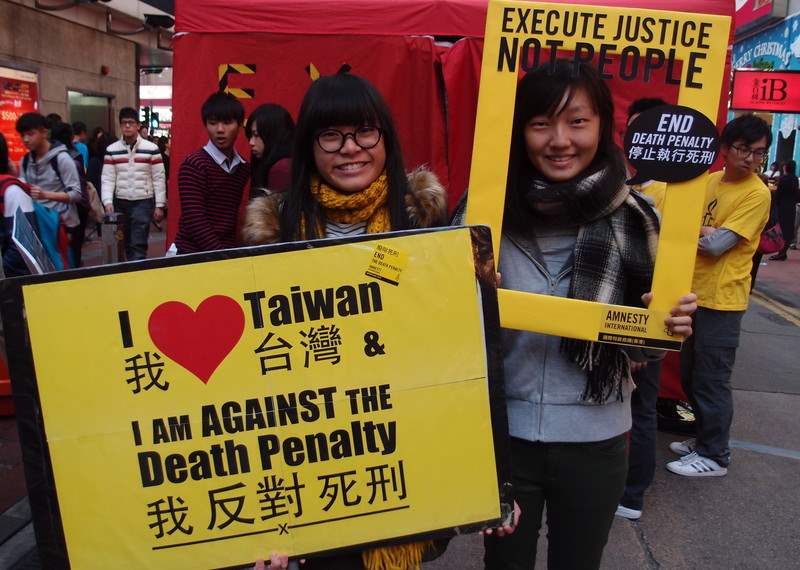
Does the decease penalty cease crime? Does it give victims justice? Is there a humane way to execute? Get your facts straight about the death penalization with Amnesty's top 10 FAQs on death sentence.
1. Why does Immunity International oppose the death sentence?
The death punishment violates the most fundamental human right – the right to life. It is the ultimate roughshod, inhuman and degrading punishment.
The death penalty is discriminatory. Information technology is often used against the almost vulnerable in lodge, including the poor, ethnic and religious minorities, and people with mental disabilities. Some governments use it to silence their opponents. Where justice systems are flawed and unfair trials rife, the risk of executing an innocent person is ever present.
When the death penalty is carried out, information technology is final. Mistakes that are made cannot be unmade. An innocent person may be released from prison for a crime they did not commit, only an execution can never be reversed.
two. Don't victims of violent crime and their families take a right to justice?
They do. Those who have lost loved ones in terrible crimes have a correct to see the person responsible held to account in a fair trial without recourse to the death punishment. In opposing the death penalization, we are non trying to minimize or condone criminal offence. But every bit many families who have lost loved ones accept said, the death penalty cannot genuinely relieve their suffering. It simply extends that suffering to the family of the condemned person.
Revenge is not the answer. The answer lies in reducing violence, non causing more than death.
Marie Deans, whose mother-in-law was murdered in 1972
3. If you kill someone else, don't you deserve to die, too – "an eye for an eye"?
No. Executing someone considering they've taken someone'southward life is revenge, non justice.
An execution – or the threat of 1 –inflicts terrible physical and psychological cruelty. Any society which executes offenders is committing the same violence information technology condemns.
iv. Doesn't the death penalty forbid criminal offence?
Not according to the research. There is no credible evidence that the death penalty deters criminal offence more effectively than a prison term. In fact, law-breaking figures from countries which have banned the capital punishment have not risen. In some cases they have actually gone down. In Canada, the murder charge per unit in 2008 was less than half that in 1976 when the death penalty was abolished there.
5. What about death penalty for terrorists?
Governments oft resort to the death sentence in the aftermath of tearing attacks, to demonstrate they are doing something to "protect" national security. But the threat of execution is unlikely to stop men and women prepared to dice for their behavior – for instance, suicide bombers. Executions are just every bit probable to create martyrs whose memory becomes a rallying betoken for their organizations.
People defendant of "terrorism" are especially likely to be sentenced to death after unfair trials. Many are condemned on the basis of "confessions" extracted through torture. In some cases, special or armed forces courts ready up through counter-terrorism laws have sentenced civilians to death, undermining international standards.
[The capital punishment] is a inexpensive way for politically inclined people to pretend to their fearful constituencies that something is beingness done to combat offense.
Jan van Rooyen, South African police force professor
vi. Isn't it better to execute someone than to lock them up forever?
Every 24-hour interval, men, women, even children, expect execution on death row. Whatever their crime, whether they are guilty or innocent, their lives are claimed by a system of justice that values retribution over rehabilitation. As long as a prisoner remains alive, he or she can hope for rehabilitation, or to be exonerated if they are later on found to be innocent.
7. Is there a humane and painless mode to execute a person?
Any form of execution is inhumane. The lethal injection is frequently touted as somehow more humane because, on the surface at to the lowest degree, it appears less grotesque and barbaric than other forms of execution such as beheading, electrocution, gassing and hanging.
But the search for a "humane" way to impale people should be seen for what information technology really is – an attempt to brand executions more palatable to the public in whose name they are being carried out, and to make the governments that execute appear less like killers themselves.
8. What business is it of Amnesty's if different societies want to use the death penalty?
Human rights – including the most basic correct to life – are universal and endorsed by the vast bulk of countries in the globe. Our call to cease the death penalty is consistent with the mercy, compassion and forgiveness that all major world religions emphasize. To date, 140 countries have abolished the death penalty in constabulary or in practice, demonstrating that the want to end capital penalty is shared by cultures and societies in near every region in the world.
Human rights apply to the best of u.s.a. – and the worst of united states.
Amnesty International
9. What if public opinion is in favour of the death punishment?
Strong public support for the death penalty often goes manus in manus with a lack of reliable information near it – most ofttimes the mistaken conventionalities that it will reduce criminal offense. Many governments are quick to promote this erroneous belief even though there is no show to support it. Crucial factors that underlie how the death penalization is practical are often not understood. These include the risk of executing an innocent person, the unfairness of trials, and the discriminatory nature of the expiry penalization – all of which contribute to a fully informed view of capital letter punishment.
Nosotros believe governments need to be open about this information, while promoting respect for human rights through public educational activity programmes. Simply then can at that place be meaningful debate on the death penalty.
Still the decision to execute someone cannot be decided by public opinion. Governments must lead the way.
10. Is the boxing to cancel the death penalty being won?
Yep. Today, two-thirds of countries in the world accept either abolished the capital punishment outright, or no longer use it in do. Although there take been a few steps backwards, these must be weighed up against the clear worldwide trend towards abolitionism. In 2022 lonely, Fiji, Madagascar and Suriname all turned their backs on the death sentence one time and for all. Burkina Faso, Mongolia and Republic of korea are on their mode to doing the same. Europe remains virtually gratuitous of the death penalty. And the U.s.a., historically ane of the nations nigh reluctant to give up the death sentence, is slowly turning confronting majuscule punishment.
Further reading
Our position on the death penalty
Is the death penalty the reply to drug criminal offense?
Capital punishment 2015: the skillful and the bad
The death penalty v. homo rights – Why abolish the capital punishment?
Death penalty campaigning toolkit (2008)
Source: https://www.amnesty.org/en/what-we-do/death-penalty/the-death-penalty-your-questions-answered/
0 Response to "Is It Fair to Kill the Violent Offender So They Won t Be a Threat Again"
Postar um comentário